Nobody tells you about the silence.
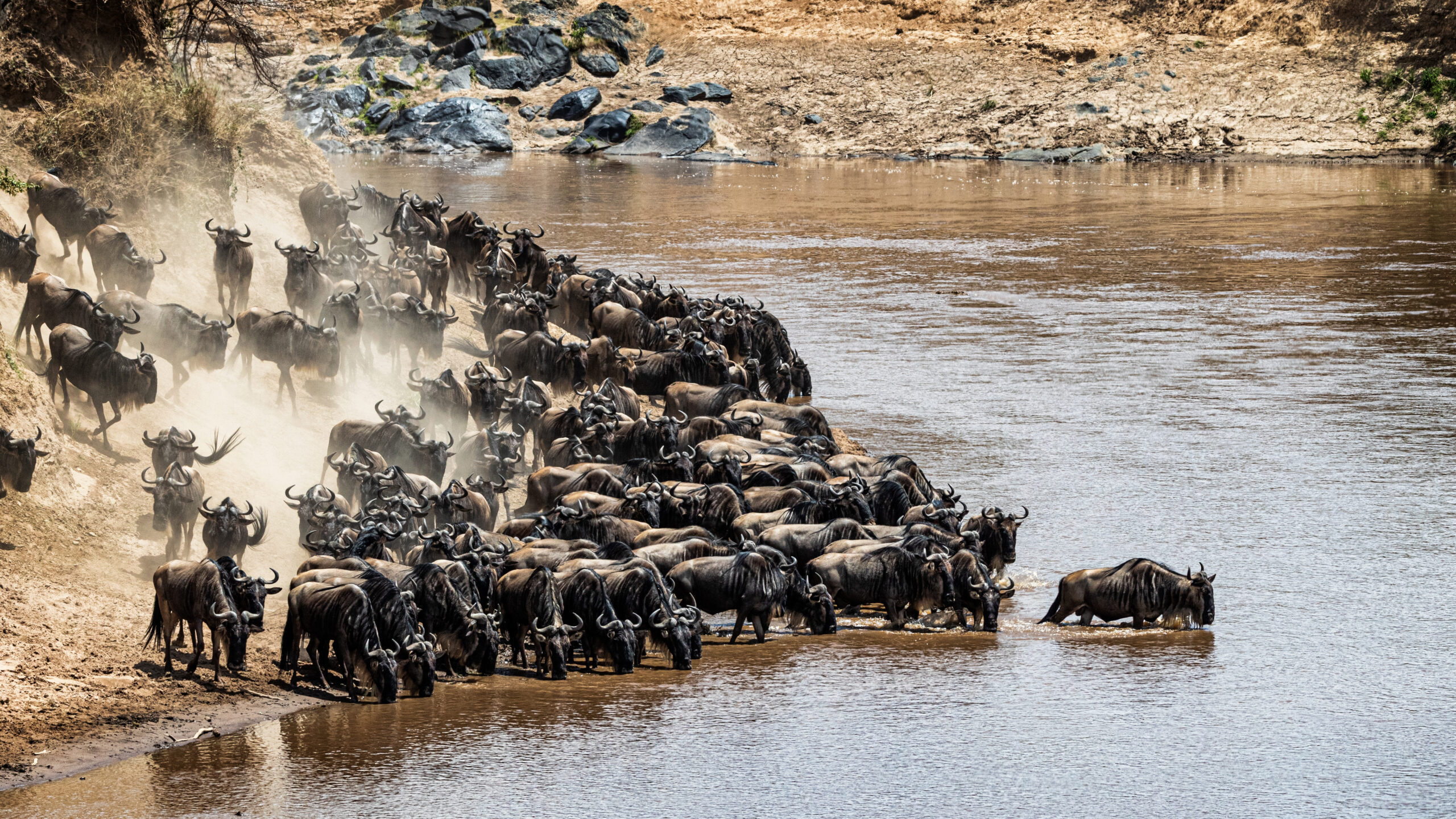
The herds have been standing at the Mara River bank for three hours. Thousands of wildebeest, shoulder to shoulder, pressing forward, then surging back. The air smells of dust and animal fear. Your guide has cut the engine. No one in the vehicle is speaking.
Then one animal always just one commits. It steps over the edge. And in the space of ten seconds, the entire bank becomes a living avalanche of hooves, muscle, and noise. The water erupts. Crocodiles enormous, ancient, patient materialise from beneath the surface. Lions appear on the far bank. The dust rises thirty metres into the air.
And then it’s over. The survivors climb the opposite bank and keep moving north, as if nothing happened. The river settles. The crocodiles sink back into the dark water. Silence.
You realise you haven’t drawn a proper breath in four minutes.
That is a Mara River crossing. No film, no photograph, no description comes close. This guide tells you exactly how to be there the timing, the preparation, the positioning, and everything in between.
What Is the Mara River Crossing?
The Mara River crossing is the defining moment of the Great Migration the annual movement of approximately 1.5 million wildebeest and 250,000 zebra in a circuit between Tanzania’s Serengeti and Kenya’s Maasai Mara, following rainfall and fresh grass.
The Mara River forms a natural barrier at the northern edge of the Serengeti, separating Tanzania from Kenya. To complete their circuit, the migration herds must cross it sometimes multiple times in both directions. These crossings are completely unpredictable, completely unscheduled, and completely extraordinary.
The river is approximately 15–20 metres wide at the main crossing points, with steep, muddy banks that animals must leap from and scramble up on the other side. It is full of Nile crocodiles some of the largest in Africa, having fed on this crossing for decades. Lions patrol both banks. The water runs fast in the rains.
It is one of the most dangerous things the wildebeest do. And they do it because they have no choice.
Why August Is the Best Month for Mara River Crossings
The Great Migration moves in a roughly clockwise circuit through the Serengeti-Mara ecosystem across the entire year. But it is only during a specific window roughly late July through October that the herds reach the Mara River in numbers large enough to trigger crossings.
August is the heart of this window. Here’s why:
- By late July, the main migration columns have moved north through the central Serengeti and are massing near the Mara River for the first major crossing attempts
- August sees the peak concentration of animals in the northern Serengeti and the Maasai Mara two million animals in a relatively small area
- Crossing frequency peaks in August as the herds push back and forth across the river between Tanzania and Kenya
- The dry season weather means clear skies, short grass, excellent visibility, and solid roads inside the park
- Predator activity is at its highest
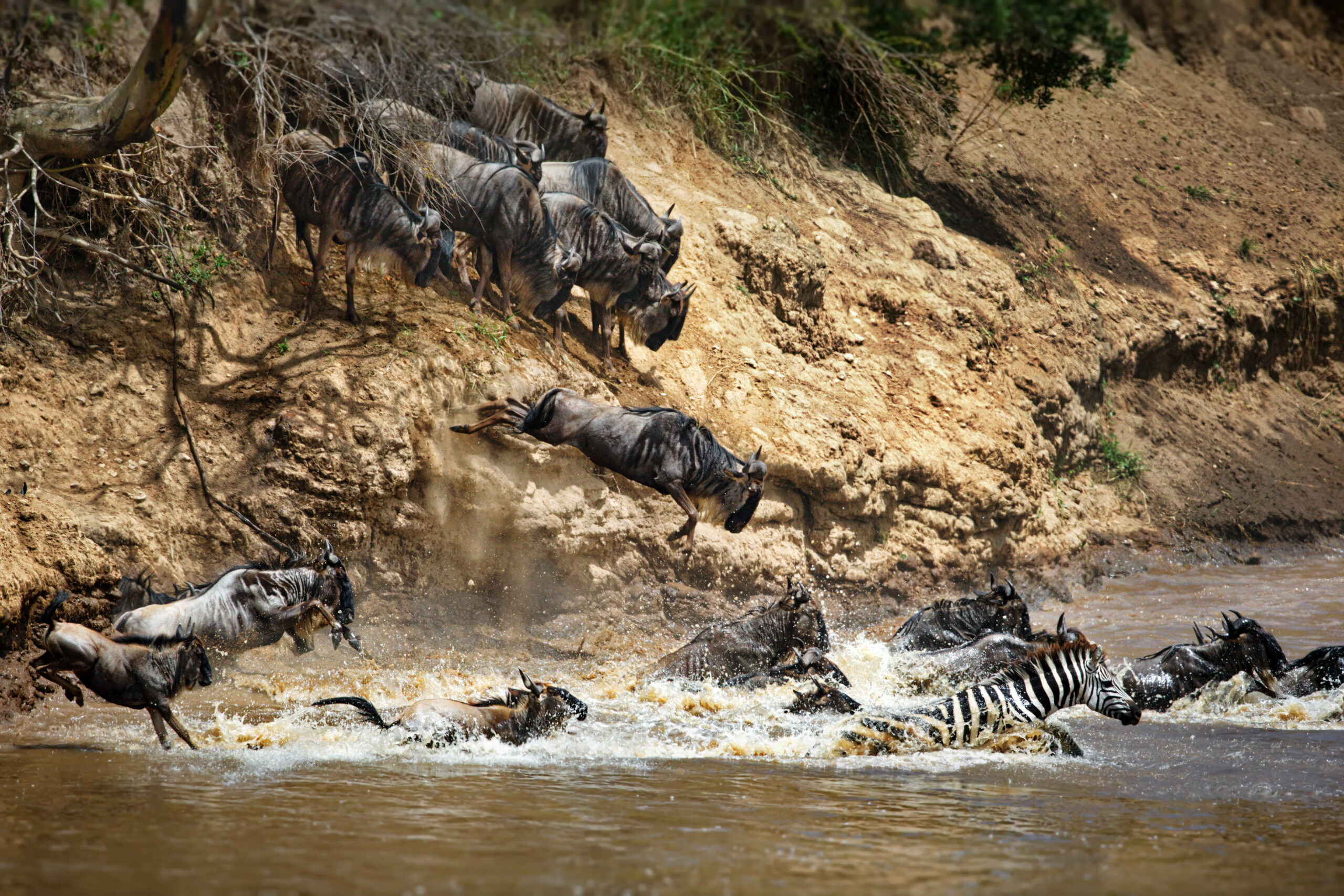
The wildebeest herd and zebras near and in the river in Masai Mara, Kenya during daylight lions, leopards, and cheetahs follow the migration north
| Month | Migration Position | Crossing Activity | Verdict for Crossings |
| June | Moving north through central Serengeti | Rare — herds approaching | Poor |
| July (early) | Western corridor and central north | Occasional — first attempts | Fair |
| July (late) | Northern Serengeti massing | Building — first major crossings | Good |
| August | Northern Serengeti / Mara River | Peak frequency — multiple daily attempts possible | Best |
| September | Crossing back and forth, Mara/Kogatende | Sustained — continued crossings | Excellent |
| October (early) | Final crossings before return south | Tapering — last significant crossings | Good |
| October (late) | Beginning return south | Rare | Poor |
INSIDER: The single best 2-week window for Mara River crossings across all years of recorded sightings is August 5–25. This is not a guarantee it is a probability based on historical herd movement patterns. Plan your peak dates around this window.
What a Crossing Actually Feels Like: A Witness Account
It starts with the sound.
Before you see anything, you hear the herds on the far bank a low rumble of hooves and body movement, a deep, constant alarm call that the wildebeest make when they sense danger and are trying to decide whether to commit. Your guide positions the vehicle at one of the known crossing points and cuts the engine immediately. ‘We wait,’ he says.
The herd builds on the opposite bank. Hundreds become thousands. The front animals press to the water’s edge, look down, look across, retreat. This can go on for minutes or hours. There is no way to predict when or whether they’ll cross.
Then: a shift in the crowd pressure, an animal that steps too far forward and cannot stop itself. The plunge. And then the herd instinct takes over entirely what was individual becomes collective, what was hesitation becomes stampede.
In the water, the crocodiles are extraordinary. They’ve been waiting, completely still, for hours. The moment the first animal hits the water, they accelerate from standstill to 20 km/h in the length of their body. The chaos is total hooves, spray, crocodile thrashes, the whites of wildebeest eyes.
At the far bank, survivors scramble up the steep mud walls. Some make it. Some don’t. The ones that emerge immediately begin walking north, toward fresh grass, continuing the journey without pause.
The whole thing can last four minutes. Your guide starts the engine. ‘Want to find another crossing point?’ he asks. You nod, because you can’t speak yet.
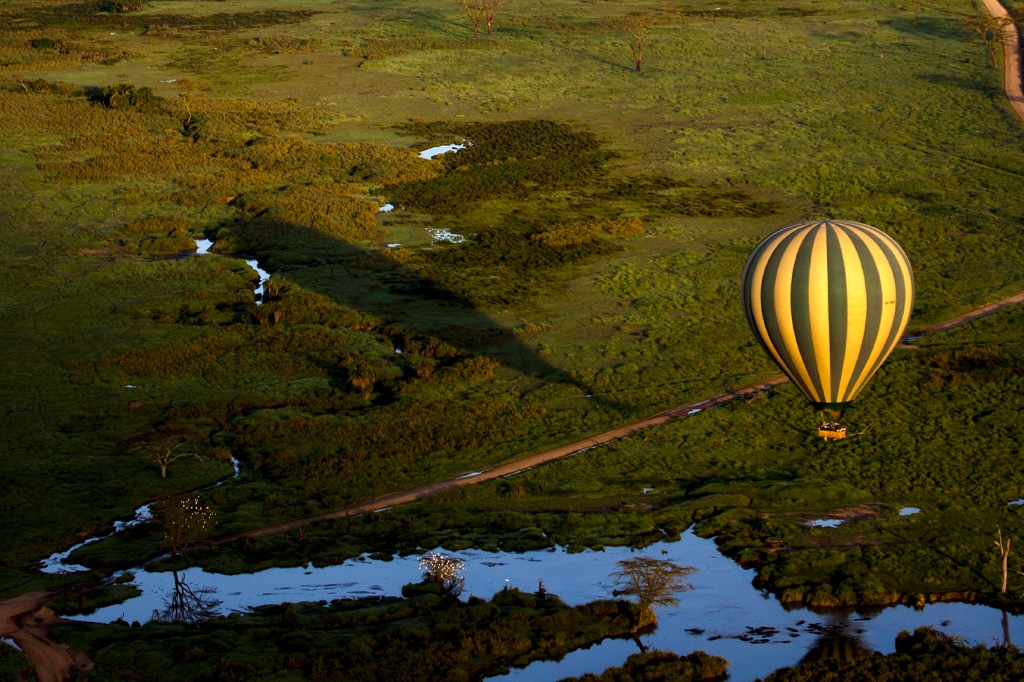
The Main Mara River Crossing Points
The Mara River has several established crossing points used by the migration herds across generations. Each has different characteristics bank height, water speed, crocodile density, vehicle accessibility and experienced guides track which points are active based on daily herd movements.
| Crossing Point | Location | Character | Best For |
| Crossing Point 1 (Lower Mara) | Kogatende area, Tanzania side | Classic steep bank, high crocodile density, frequent use | Dramatic crossings, photography |
| Crossing Point 6 (Upper Mara) | Kogatende, Tanzania | Shallower crossing, faster water, different angle | Alternative when CP1 is congested |
| Serena Crossing | Central Mara region | Wider river, less steep, more gradual entry | Calmer crossings, good for families |
| Lookout Hill Crossing | Northern Kogatende | Elevated viewpoint option, wide vista | Aerial perspective of full herd |
| Mara Triangle Crossings (Kenya side) | Maasai Mara, Kenya | Multiple points, off-road access permitted | Photographers, flexibility |
Your guide will not tell you in advance which crossing point you’ll go to because it’s determined each morning by fresh sighting information from the scout network. The best operators communicate via radio with colleagues positioned across the northern zone to triangulate where the herds are massing and which point looks most likely to trigger.
Trust the process. Do not ask to switch crossing points based on your own instinct your guide’s network sees the full picture. You see a patch of riverbank.
How to Position Yourself for a Mara River Crossing
Arrive at the Crossing Point Early
Be at the river by 6:30 AM. Crossings can happen at any time of day, but early morning is the highest-probability window the herds have been resting overnight on the plains and begin moving toward water as temperatures rise. The light at 6:30–9:00 AM is also the best for photography warm, directional, golden.
Stay Still and Stay Quiet
When a herd is massing at the bank, your guide will cut the engine and stop the vehicle. This is non-negotiable. Engine noise and vehicle movement spooks the lead animals and can delay or abort a crossing entirely. Stay in the vehicle, don’t wave, don’t talk above a whisper. The patience required is real but it is directly connected to what you’ll see.
The Waiting Game
A herd may wait at a crossing point for 20 minutes or 6 hours. There is no way to predict which it will be. The decision to cross is made by the collective triggered by a combination of population pressure, predator activity, water level, and what appears to be individual animal psychology that researchers have studied for decades without fully understanding.
The waiting is part of the experience. Watch the herd behaviour the agitation, the surging, the retreat. You’re witnessing a decision being made by two million years of evolution, in real time.
PATIENCE TIP: Bring snacks, water, a book, and a second battery for your camera. Be ready to wait 4+ hours at a crossing point. The clients who see the best crossings are not the luckiest they’re the most patient.
What Happens at the Crossing
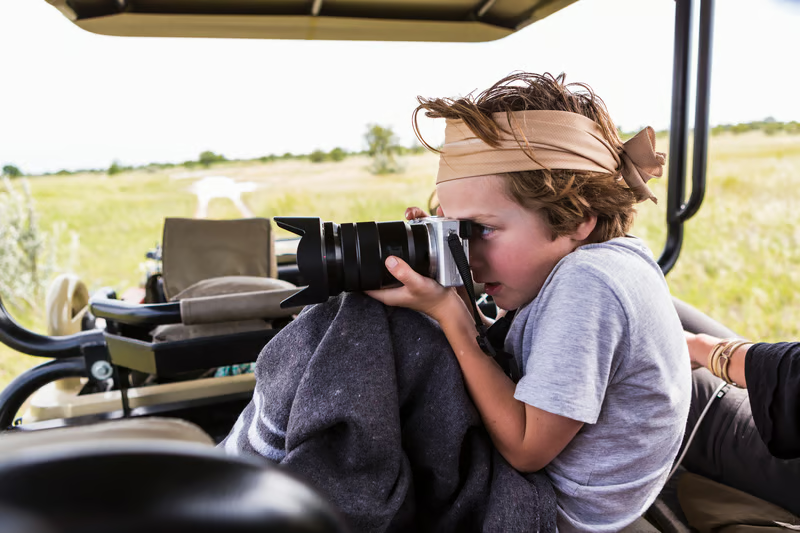
Once the crossing begins, events move faster than you expect. Have your camera ready and settings pre-dialled manual focus on the bank edge, shutter speed 1/1000s minimum, burst mode enabled. The action window for the most dramatic moments (first animal leaping, crocodile strike, mass crossing chaos) can be under 60 seconds.
After the initial rush, crossings often continue for 15–30 minutes as the remaining herd follows. This second phase is calmer and allows for more considered photography — individual animals, close-up expressions, survivor scrambles up the far bank.
Wildlife at the Mara River: Beyond the Crossing
Nile Crocodiles
The Mara River’s crocodile population has grown over decades to take advantage of the annual crossing. These are large animals the biggest individuals in the northern Serengeti are estimated to be 50–70 years old, over 5 metres long, and capable of taking an adult wildebeest in a single strike.
Outside crossing events, the crocodiles are visible basking on the river banks year-round. The Mara River’s crocodile density at crossing points is among the highest in Africa. Your guide will know where the largest individuals typically hold their territory.
Lions at the Crossing
Lions learn the crossing calendar. Northern Serengeti lion prides position themselves at crossing points during migration season, ambushing animals that are exhausted and disoriented from the river crossing. Witnessing a simultaneous crocodile attack in the water and lion ambush on the far bank both targeting the same animal is one of the rarest and most powerful wildlife events in Africa.
Vultures and Scavengers
Every crossing leaves casualties. Lappet-faced vultures, white-backed vultures, and marabou storks gather at crossing points throughout migration season, feeding on drowned animals that float downstream. The scavenger activity at the river is constant from July through October an ecological function as important as the crossing itself.
Hippos
The Mara River has large hippo pods year-round. During crossings, hippos typically move to the edges of the river they are not predators of wildebeest but the chaos of a mass crossing forces them to relocate temporarily. Outside crossing events, hippo pods at the Mara River are among the most accessible in Tanzania.
Photographing the Mara River Crossing: Expert Tips
Camera Settings
| Setting | Recommended Value | Why |
| Shutter speed | 1/1000s minimum (1/2000s ideal) | Freeze motion of crossing animals and crocodile strikes |
| Aperture | f/5.6 – f/8 | Depth of field to keep multiple animals sharp |
| ISO | Auto, 400–3200 range | Morning light is variable — let ISO compensate |
| Focus mode | Continuous / AI Servo | Track moving animals across the frame |
| Drive mode | High-speed burst (8–12fps) | Capture peak action across entire crossing sequence |
| White balance | Cloudy or Auto | Warm morning light benefits from Cloudy WB |
Lens Choices
- 70–200mm f/2.8: Ideal for context shots of massing herds and wide crossing scenes
- 400mm f/5.6 or 100–400mm zoom: Best for close-up action, individual animals, crocodile strikes
- 500mm+ prime: Maximum reach for far-bank action and telephoto compression of the herd
- Wide angle (24–70mm): For vehicle interior context shots and landscape establishing frames
A 400mm or 100–500mm zoom on a crop sensor body is the single most versatile setup for crossing photography. The crop factor gives effective reach of 640–800mm while maintaining autofocus performance.
Position and Light
The light direction at your crossing point determines your photography angle. At most Kogatende crossing points, east-facing banks catch the best morning light (6:30–9:30 AM). Discuss with your guide which crossing point offers the best light angle for your specific shoot priorities this is a legitimate and welcomed question from any photographer.
Planning Your August Mara River Safari: Complete Guide
How Many Nights Do You Need?
This is the most common planning mistake: booking one or two nights in northern Serengeti for August crossing season and expecting to see a crossing.
The reality: crossings are unpredictable. Herds may wait at a point for two days before committing. A single day at the river could produce nothing — or the most dramatic crossing of the season. Three nights gives you enough attempts to significantly increase your probability.
| Duration in Northern Serengeti | Crossing Probability (August) | Recommendation |
| 1 night (2 game drives) | ~35–45% | Not recommended — too high a risk of missing |
| 2 nights (4 game drives) | ~60–70% | Acceptable minimum for most travelers |
| 3 nights (6 game drives) | ~85–90% | Recommended — allows multiple attempts |
| 4+ nights (8+ game drives) | ~95%+ | Best — allows selective positioning and patience |
Where to Stay for August Mara River Access
| Camp | Tier | Distance to Mara River | Notes |
| Sayari Camp (Asilia) | Luxury | 10–15 min drive | Northernmost camp, closest to main crossings |
| &Beyond Serengeti Under Canvas (Kogatende) | Luxury | 15–20 min drive | Seasonal camp, moves with migration |
| Asilia Lamai Serengeti | Luxury | 20–30 min drive | Lamai Wedge — elevated position, excellent vista |
| Ubuntu Migration Camp | Luxury | 15–25 min drive | Intimate camp, strong guide team |
| Lemala Kuria Hills | Upper Mid | 20–30 min drive | Best value for northern zone, solid guiding |
| Serengeti Bushtops Camp | Luxury | 25–35 min drive | Good food, strong photography focus |
BOOKING REALITY: Top northern Serengeti camps for August sell out 10–12 months in advance. If your August trip is less than 6 months away and you haven’t booked, your first-choice camps may be unavailable. Act immediately don’t wait.
August Safari Cost Breakdown
| Cost Element | August Peak Cost (Per Person) |
| Northern Serengeti camp (3 nights, luxury) | $4,500 – $7,500 |
| Central Serengeti camp (2 nights, mid-range) | $700 – $1,400 |
| Charter flights (Arusha → Seronera → Kogatende → Arusha) | $750 – $1,200 |
| Tanzania park fees (5 days) | $410 |
| International flights (return, economy, Europe) | $800 – $1,400 |
| Travel & evacuation insurance | $150 – $300 |
| Guide + camp tips (5 days) | $175 – $250 |
| TOTAL ESTIMATED (MID-RANGE NORTHERN FOCUS) | $7,500 – $12,500 per person |
| TOTAL ESTIMATED (LUXURY NORTHERN FOCUS) | $14,000 – $22,000 per person |
Mara River Crossing: Myths vs. Reality
| Common Myth | The Reality |
| Crossings happen every day in August | False. Crossings are entirely unpredictable some days produce multiple events, others none. Patience over multiple days is required. |
| You can schedule your arrival around a crossing | False. No operator can predict a crossing more than 2–3 hours in advance. Tracking is real-time, not pre-planned. |
| Bigger herds = more dramatic crossings | Not always. Smaller groups of 200–500 animals sometimes produce more focused, closer crossings than vast stampedes. |
| The best crossings are on the Tanzania side | Both Tanzania (Kogatende) and Kenya (Mara Triangle) produce exceptional crossings. Kenya’s private conservancies allow off-road vehicle positioning — an advantage for photography. |
| You need to be in the Serengeti for the whole August | 3–4 nights in northern Serengeti in August is sufficient for most travellers to see at least one crossing. |
| Crossings are dangerous for safari visitors | Completely safe. Vehicles remain a minimum distance from the river. Guides are experienced at positioning for safety and viewing simultaneously. |
Sample 7-Day August Mara River Crossing Itinerary
| Day | Location | Focus | Overnight |
| Day 1 | Fly Arusha → Seronera (Central Serengeti) | Afternoon arrival game drive — lions, leopards | Central Serengeti camp |
| Day 2 | Central Serengeti (Seronera Valley) | Full day — Seronera big cats, hippo pool, kopjes | Central Serengeti camp |
| Day 3 | Fly Seronera → Kogatende (Northern Serengeti) | Afternoon arrival — first Mara River reconnaissance | Northern Serengeti camp |
| Day 4 | Northern Serengeti — Mara River | Full day crossing watch — dawn to dusk at the river | Northern Serengeti camp |
| Day 5 | Northern Serengeti — Mara River | Second full day crossing attempt — Lamai Wedge afternoon | Northern Serengeti camp |
| Day 6 | Northern Serengeti — Mara River | Third crossing attempt, Kogatende plains cheetah search | Northern Serengeti camp |
| Day 7 | Fly Kogatende → Arusha | Morning game drive on plains before flight | Arusha / depart |
Extend this itinerary by adding Ngorongoro Crater (Days 7–8) or a Zanzibar beach extension (Days 8–12) for a complete Tanzania experience.
Mistakes That Cost You the Crossing
- Booking only 1–2 nights in northern Serengeti insufficient time for probability to work in your favour
- Expecting a crossing at a specific time or day the wildlife operates on no human schedule
- Making noise or moving when herds are massing at the bank this can abort a crossing entirely
- Leaving the crossing point midday to return to camp for lunch many crossings happen between 10 AM and 2 PM
- Not pre-dialling camera settings before arriving at the bank the action begins with no warning
- Booking late August northern Serengeti camps fill 10–12 months in advance; anything less than 6 months risks settling for second-best positioning
- Choosing camp on price alone guide quality and camp proximity to the river are everything in August
Frequently Asked Questions
FAQ 1: When is the best time to see the Mara River crossing?
The best time for Mara River crossings is late July through September, with August being the peak month. The migration herds reach the northern Serengeti and Maasai Mara border in highest concentration during this period, creating the greatest frequency and scale of river crossing events. Within August, the window of August 5–25 has historically produced the highest crossing frequency based on multi-year migration tracking data.
FAQ 2: How long does a Mara River crossing last?
Individual crossing events vary enormously. A small herd crossing can be over in 3–4 minutes. A major crossing involving tens of thousands of animals can continue in waves for 30–45 minutes. Before the crossing the massing of herds at the bank can take anywhere from 20 minutes to 6 hours. The total experience at a productive crossing point, from first herd arrival to final animal clearing the bank, may span half a day.
FAQ 3: Is it guaranteed to see a Mara River crossing in August?
No wildlife event is guaranteed, but August offers the highest probability of the entire year. With 3–4 nights in northern Serengeti and an experienced guide with a strong scout network, most visitors see at least one crossing. The probability of seeing at least one crossing in 3 nights during peak August is estimated at 85–90% by experienced northern Serengeti operators. It is not 100% and accepting that uncertainty is part of what makes the experience genuine.
FAQ 4: How do I book an August Mara River crossing safari?
Book as early as possible ideally 10–12 months in advance for August. Top northern Serengeti camps (Sayari, Lamai, &Beyond Kogatende) sell out entirely by October–November of the preceding year for the following August. Work with a TATO-licensed Tanzania-based operator who has direct camp relationships and can advise on real-time availability. Confirm that your operator uses a scout radio network for real-time crossing tracking.
FAQ 5: What should I bring to a Mara River crossing?
Camera with 300mm+ telephoto lens and extra batteries (the wait is long), binoculars (8×42 minimum for scanning the river and far bank), snacks and water for a full day at the crossing point, a warm layer for dawn (northern Serengeti at 6 AM in August can be 10–12°C), sun protection for midday, and patience. The most important thing you bring to a Mara River crossing is time plan to stay at the river for as long as it takes.